

your best work doesn't require your worst pain
what nobody tells you about creating from a full place

Dear friends,
I've been sitting with a confession for weeks now, turning it over, suspicious of it. Waiting for the catch.
Here it is. I am, without question, the happiest I've ever been. And as a result, creating has never felt this easy.
This terrifies me. Because for most of my life, I’ve lived by a rule I never consciously chose but completely believed. That the real work or what I will call the important work in the grand scheme of my life had to be born of suffering. That it would arrive only through the desperate clawing for what I did not have. So I cultivated an inner life that was forever restless, as if turmoil were a prerequisite for meaning. Everything suspended, always, in service of the work.
I built an entire identity around this belief. And now I’m sitting here, happy and creatively overflowing, and I don’t quite know what to do with the contradiction.
That my creativity does not demand suffering as its raw material.
But I’m getting ahead of myself.
The American Dream, or: How I Became What I Was Trying to Escape
Here’s something else I need to confess, because it connects to everything that follows.
I spent years quietly subscribing to what I saw as a particularly capitalist way of understanding worth. The relentless productivity gospel. The idea that my value maps directly onto my output, that rest is something I have to earn, and the correct response to any creative or professional lull is to work harder.
Capitalism didn’t invent this logic from nothing. The Protestant work ethic states that labour itself was morally virtuous and that prosperity was evidence of God’s favour. This predates industrial capitalism but provided its philosophical infrastructure. By the time Adam Smith was writing The Wealth of Nations in 1776, the idea that individual productive effort was the engine of social good had been building for centuries. It needed a face. It got the American Dream.
The American Dream, in its original 1931 formulation by historian James Truslow Adams, wasn’t about getting rich. It was about something stranger and more seductive. The idea that “life should be better and richer and fuller for everyone, with opportunity for each according to ability or achievement.” The belief that where you started wasn’t where you had to end. That effort, sufficiently applied, could transform circumstance.
By 2025, this has metastasised into something that would be unrecognisable to Adams. The average American worker is 400% more productive than they were in 1950, according to Economic Policy Institute data, but real wages have barely kept pace. We’ve accepted the logic of infinite productivity as a personal virtue entirely divorced from its original promise. The work was supposed to deliver a better life, not consume it.
And despite my ideological objections to all of this, I look at my own life and find, with something between amusement and horror, that I have been its perfect candidate. The obsessive work habits, guilt about unproductive Sundays. All this and the quiet belief, never fully examined, that I hadn’t yet done enough to deserve rest.
I thought I was rebelling against a system. I was instead executing its logic with precise efficiency. This matters for what comes next. Because this same logic that value requires suffering and that good work comes from hard places also colonised how I thought about creativity.
The Patron Saint of Suffering
The story goes like this. The artist is someone who transforms pain into beauty. Who metabolises their own damage into work that outlasts them. They earn their art through lived suffering.
It’s not a new story. Van Gogh, obviously, always Van Gogh, the patron saint of the suffering artist myth, the man whose ear we remember almost as much as his paintings. Virginia Woolf, filling her pockets with stones and walking into the River Ouse. Kurt Cobain, Amy Winehouse, the entire morbid canon of the 27 Club. Artists whose suffering we’ve romanticised into a narrative about the price of genius.
The story we tell is that their pain was the source of their art. That they created because they suffered, and that their suffering made the creation authentic, gave it weight, made it mean something.
We tell this story so often that it starts to feel like a natural law. Great art requires great pain.
But we made an error. We saw correlation and called it causation.
By romanticising the damage, we forget to ask whether these artists created despite their suffering, not because of it. Whether the pain was an obstacle they worked around, a thief that stole years of potential work, or the fuel that powered it.
What if generations of creatives have internalised the belief that they need to be broken to make something beautiful, and what if that belief has broken them? On further inspection and research, I found that the mythology of the suffering artist isn’t a description of how creativity works but a prescription that has caused immeasurable harm at times, like artists refusing treatment, avoiding stability and seeking out pain because they’ve been told it’s the only path to authenticity.
I think about all the work we’ve lost. The albums never made because the artist died too young. The novels never written because the writer couldn’t survive their own mythology. The paintings, the films, the scientific discoveries, the inventions—all the things that would have existed if we’d told a different story about what creativity requires.
We do this to living artists, too. We demand that they suffer for our entertainment, and then we consume their pain as content.
There’s a famous pop star—you know who I mean, I don’t need to name her—who has been told her best albums have come from heartbreak and the dissolution of relationships.
We’re saying that for her to make the music we love, she has to be miserable. We’re making her suffering a condition of her value.
This is obscene and something we should refuse. And yet I catch myself thinking it too. When an artist I love releases an album that feels lighter, more content, I notice a small jab of disappointment in myself. A sense that they’ve lost their edge.
I hate that I think this. I’m trying to unlearn it.
When the Mine Runs Dry
Don’t get me wrong. I’m not saying suffering has no relationship to art. I’ve made work from my own dark places. Some of my best writing and projects has come from excavating pain since I was thirteen years old, from going into the depths and bringing something back. There’s a truth in that. Difficulty can be generative and wrestling with hard things can produce insight.
But excavation only goes so far. You can only mine the same wounds so many times before the vein runs dry. And it’s extractive, treating your own pain as a resource to be exploited rather than an experience to be healed.
There is a kind of art that requires pain as its precondition. I don’t want to dismiss this. The elegy or the witness poem. The memoir of surviving something unsurvivable. These exist and they can only be made by people who have been through the fire and come out the other side with language intact.
But there is another kind of art—equally real, equally necessary—that requires something else entirely. Spaciousness. Time. The ability to look at a thing without flinching because you’re not in the middle of it anymore. The gentle quality of attention and material that becomes available when you’re not in survival mode.
I did this for years. I strip-mined my own suffering for material. And it worked, for a while, until it didn’t. Until I found myself in a strange position.
Happier than I’d ever been, and terrified that the happiness would kill my creativity.
News flash. It didn’t.
That’s what I want to tell you. That’s the thing I’m still marveling at, which contradicts everything I was taught to believe.
I am the happiest I’ve been in my adult life. I am loved. I am stable. I have work that matters to me and relationships that nourish me and a sense of possibility that I haven’t felt since I was a child. And I have never—never—been more creatively alive.
The ideas come faster than I can catch them. I fall asleep thinking about projects and wake up with solutions to problems I hadn’t consciously been working on. I write more easily, more fluently, with less of the grinding resistance that used to characterise my process. The work feels less like extraction and more like overflow—not pulling something out of myself but letting something flow through.
I don’t know how to explain this except to say. I think I was lied to. I think we were all lied to. I think the story about suffering and creativity was never true, or was only partially true, and the partial truth was weaponised into an ideology that has caused tremendous harm.
What Gets Made in the Light
Let me tell you about some artists who created from fullness rather than lack.
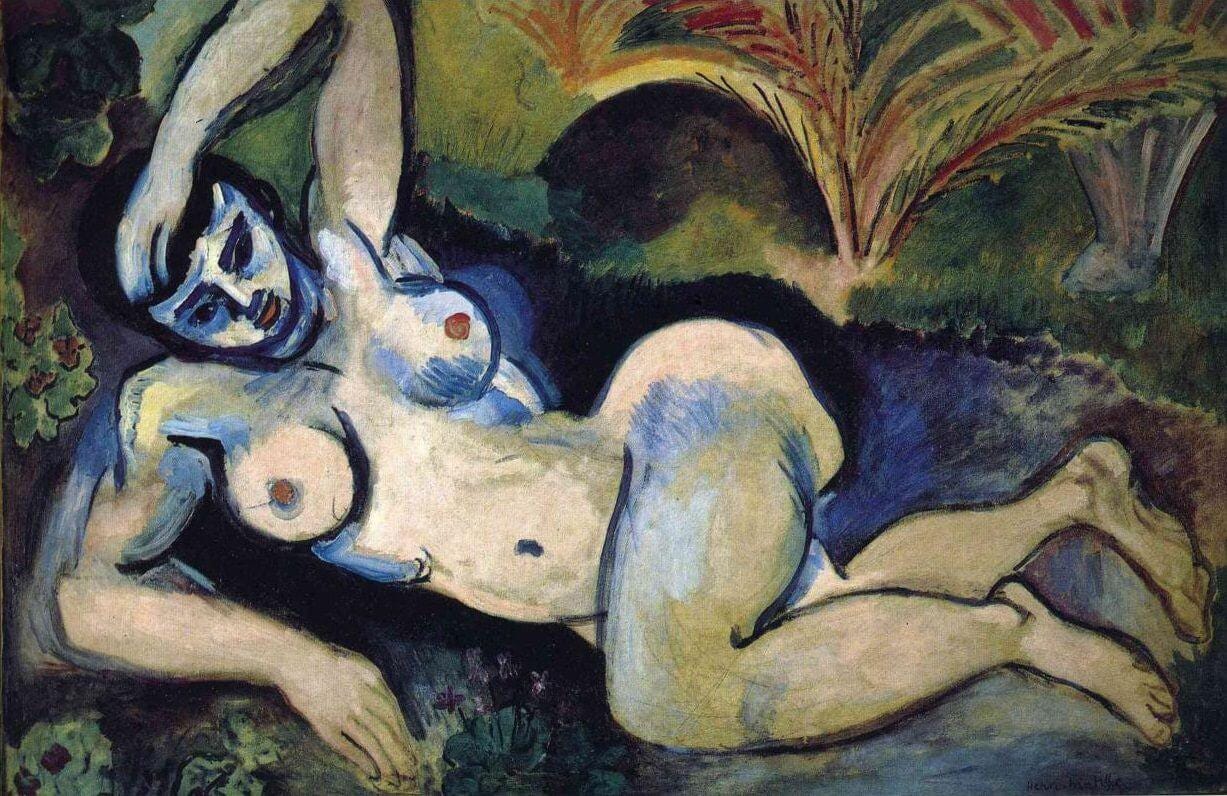
My darling, Henri Matisse, in his seventies and eighties, bedridden and unable to paint, invented an entirely new art form. He called it “painting with scissors”—large-scale paper cutouts in vivid colors, shapes that seemed to dance across the walls of his studio. This was not work made from suffering.
This was work by a man who described his artistic goal stemming from “an art of balance, of purity and serenity, devoid of troubling or depressing subject matter... a soothing, calming influence on the mind, something like a good armchair.” The cutouts—works like The Snail and The Blue Nude—are among the most joyful objects in the history of art. They were made by a man who was physically limited but spiritually expansive, who had found a way to create that didn’t require anguish.
Toni Morrison wrote Beloved while working full-time as an editor at Random House and raising two sons as a single mother. This was not a woman in romantic torment, not a figure of dramatic suffering. This was a woman with a job and children and a disciplined writing practice, who woke early to work before the rest of her life demanded her attention. And she produced one of the greatest novels in the American canon.
The stability gave her the container. The routine gave her the space. The fullness of her life fed the fullness of her work.
The scientists understood this differently. Darwin spent years developing his theory of evolution at Down House in Kent, in what was by most accounts a comfortable domestic life—a happy marriage, children he adored, a garden he tended obsessively. He was often ill, yes, but the conditions of his intellectual work were stability, routine, and enough. On the Origin of Species was the product of two decades of patient, sustained thinking from a man with a good life.
Marie Curie’s discoveries accelerated when she had collaborators, community. When she had her Pierre working alongside her. Her Nobel Prize—the first of two—came when she was, by her own account, deeply in love and doing the work alongside someone who matched her intellectual intensity.
Creation as partnership. Creation from being held.
I think about what these examples have in common. All of these people faced obstacles and setbacks. But they lived a life that could hold the creative work. A container sturdy enough to support the making.
This is what I didn’t understand for so long. I thought creativity required emptiness—a void that demanded to be filled, a wound that demanded to be expressed. But maybe creativity requires the opposite. Maybe it requires fullness.
A life so rich that it overflows, that it can’t help but spill into making.
The empty vessel has nothing to pour out. The broken vessel can’t hold anything at all. But the full vessel—the one that’s been filled with love and rest and experience and attention—that vessel runs over. That’s where the work comes from.
The Economics of Suffering
Maybe we’ve over-romanticised suffering as a prerequisite for good art. Maybe having a life worth living is not a distraction from the work. It is the work’s condition.
I’ve been reading about the economics of creative work, trying to understand how we got here.
The data is grim. Artists in India earn a median income well below the national average. The majority of working artists have no health insurance through their creative work. The gig economy has made stable employment in creative fields increasingly rare, while the myth of the passionate artist who doesn’t need money has been used to justify poverty wages.
And yet artists keep making work. They keep suffering for it. They keep believing that the suffering is necessary, even noble.
What would it mean to refuse this? To insist that artists deserve stability, deserve healthcare, deserve lives that aren’t organized around economic precarity? To believe that creative work might actually be better—not worse—if the people making it weren’t constantly afraid?
There’s a chicken-and-egg question here that I keep turning over. Did we start believing that suffering produces creativity, and then structure our lives and systems to make artists suffer? Or did capitalism need a story that made suffering productive, and conscript creativity into that narrative?
I suspect it’s both, feeding each other in a loop that’s hard to interrupt.
The economic system needs workers who will endure miserable conditions. It needs people who believe that their suffering has meaning, that it’s building toward something, that the pain is the price of future reward. And the myth of the suffering artist serves that system perfectly. It tells creative people that their hardship is not a bug but a feature—that economic precarity, lack of healthcare, impossible hours, constant rejection, all of it is somehow necessary for the work. It transforms systemic failure into individual virtue.
Meanwhile, artists internalize the myth and start to believe that their pain is what makes them special.
This is how ideology works. It makes us police ourselves so thoroughly that external enforcement becomes unnecessary.
What Creating from Fullness Actually Feels Like
I am trying to describe something I haven’t seen described very often, which is why it took me so long to trust it.
Lately, the work is coming from somewhere different. Fuller. Steadier. More loved than I expected to be at this point in my life, and more secure in what I’m trying to make and why.
And instead of making the work smaller—instead of dulling the edges, removing the stakes, making things safer and therefore less interesting—it has made the work wider. More spacious. Softer in the places where softness serves, braver in the places where bravery is needed.
I am, right now, more pregnant with ideas than I have ever been. More projects I want to tinker with and build. More essays half-formed in notebooks and sentences arriving in the shower, on walks, in the middle of conversations, at 2am, demanding to be written down before they evaporate.
This is not what I was told to expect from happiness.
I want to be careful here. I’m not saying that all difficulty is bad, that struggle has no value, that we should pursue frictionless lives. Some resistance is necessary. Some challenges make us grow. The swimmer becomes stronger by pushing against the water, not by floating in a void.
But there’s a difference between chosen difficulty and imposed suffering. And mostly, between the resistance you seek out because it makes you better and the deprivation that’s forced on you by a system that doesn’t value your work. The first is training. The second is abuse.
And I think we’ve confused them. We’ve told artists that all their suffering is the first kind—meaningful, productive—when much of it is actually the second kind—pointless, destructive and imposed by a society that has failed to support creative work.
I think about what it would mean to tell a different story. To celebrate the artists who create from contentment as loudly as we mythologise the artists who create from anguish. To build systems that support creative lives rather than systems that demand creative suffering.
This feels almost utopian. And naive. The cynic in me wants to dismiss it as wishful thinking, as a privileged fantasy that ignores the real conditions of creative labour.
But I keep coming back to my own experience.
For the first time in my life, I believe that the happiness is not temporary. I believe that what’s steady can sustain creation just as well as what’s broken—and maybe, if we’re being honest with each other, better.
The question was never “how much pain do you have to offer?”
The question was always just, “what do you have to say?”
Turns out, when you’re not in the middle of suffering, the answer gets clearer.

Present company -
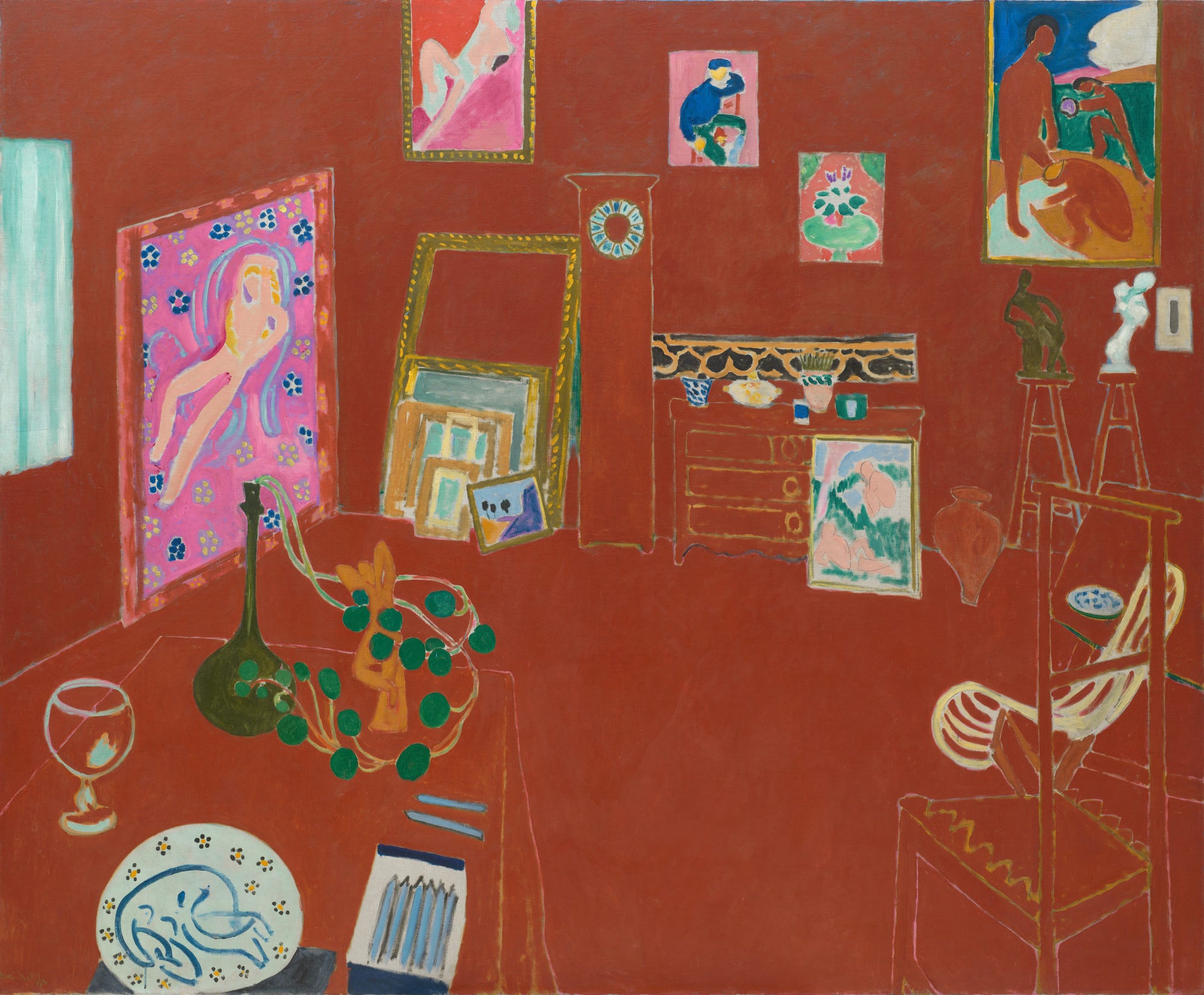
Currently on my desk: one almost-filled traveler’s journal and a rolled-up print of Matisse's Blue Nude II that I keep meaning to frame but haven't yet.
This week’s find: Love Story: John F. Kennedy Jr. & Carolyn Bessette on FX. I don't usually do parasocial about other people's love, but they've been my favorite edgy NY couple since I first saw that grainy photo of them arguing in Washington Square Park. This retelling captures perfectly how being watched ruins intimacy. Completely hooked.
Songs for excavating thoughts: Fleet Foxes, "Mykonos" / Stevie Wonder, "Cherie Amour" / Geese, "Cowboy Nudes"

P.S. If you found meaning in these words, please consider sharing with others who might like it. This space thrives on curiosity and connection.